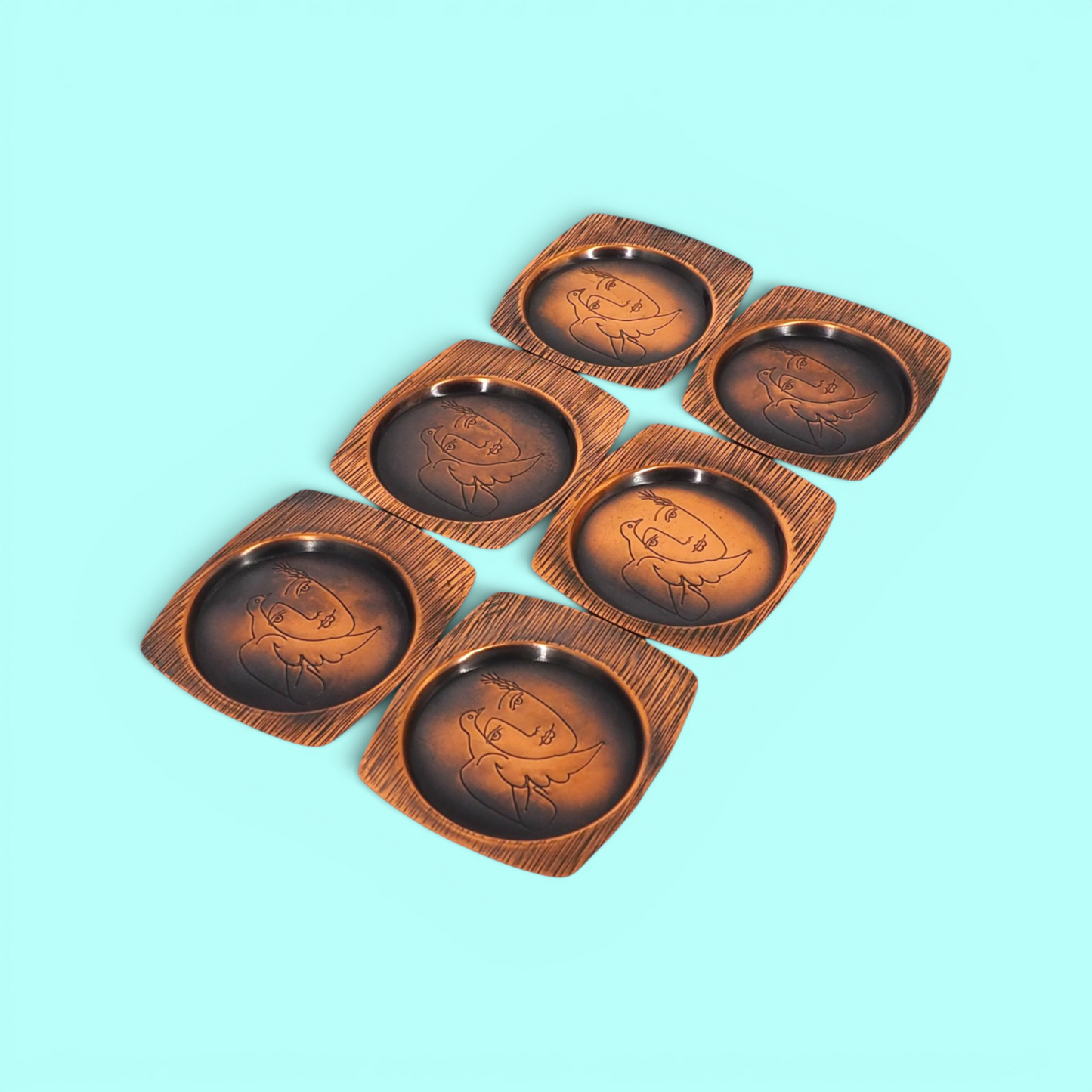
Copper coasters with Picasso "Face of Peace" | Poland, 1970s
Copper coasters with Picasso "Face of Peace" | Poland, 1970s
Couldn't load pickup availability
A set of six copper coasters produced by Spółdzielnia Warta in Poland during the 1970s. Each coaster features a graphic reproduction of Pablo Picasso's "Face of Peace" – a simplified linear portrait that became one of the artist's most widely disseminated images following its creation for the 1950 World Peace Congress in Sheffield. The coasters retain their original packaging.
Spółdzielnia Warta's production of these coasters represents the intersection of political symbolism, licensed or appropriated imagery, and domestic metalwork manufacturing during the PRL era.
SKU:SER-202
Key features
Key features
Condition
Condition
Dimensions
Dimensions
Perfect for
Perfect for
Shipping & pickup
Shipping & pickup
SLOY quality standard
SLOY quality standard
All vintage objects are carefully inspected and cleaned before sale. We ensure every piece meets our standards for authenticity and condition.
Designer
Designer
Pablo Picasso (1881–1973) was a Spanish artist who spent most of his creative life in France, where he became a leading figure in 20th-century art. His work in painting, sculpture, printmaking, and ceramics transformed the principles of visual representation, primarily through his collaborative development of Cubism with Georges Braque. The motif of "Faces of Peace" originates from his work for the peace movement—easily replicated works. Another lithograph, "Dove of Peace," was chosen as the poster for the World Peace Congress in Paris, and the artist began sketching for this series during a visit to Wrocław in 1948. The presence of Picasso's image on Polish cooperative products reflects both his ideological affinity with socialist states and the deliberate dissemination of his symbols of peace as tools of cultural diplomacy during the Cold War.
Manufacturer
Manufacturer
Spółdzielnia Warta was a Polish workers' cooperative operating during the PRL period. Like many spółdzielnie of the era, Warta produced decorative and functional household goods within the planned economy system, distributing through state retail networks. The cooperative's metalwork – including items in copper, brass, and other base metals – exemplifies the middle ground Polish manufacturers occupied between industrial production and craft tradition. The use of recognisable artistic imagery on such products was common practice, with varying degrees of formal licensing depending on the source material and international copyright enforcement of the period.